Peptides,
without the guesswork.
We carry twenty-six compounds, not thousands. Small enough that we can tell you where each one was made and what its last batch tested at.
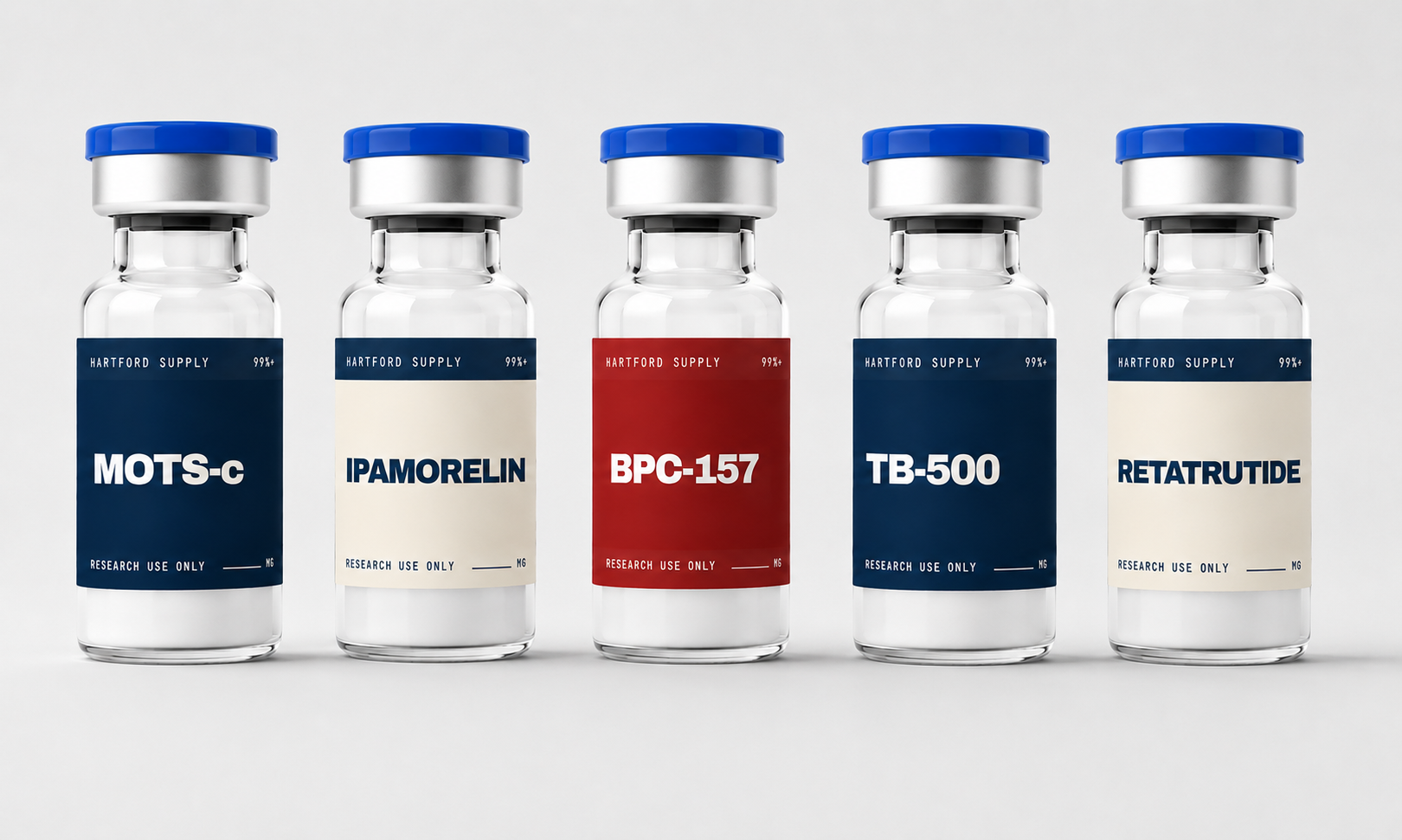
How peptides actually work.
Short chains of amino acids linked in precise sequences. The body already uses them everywhere as hormones, neurotransmitters, growth factors, immune messengers. Because they're built from materials the body recognises, they tend to be remarkably selective.
Metabolism
Insulin response, adipose tissue, appetite regulation.
Recovery
Tissue repair, angiogenesis, and healing pathways.
Cognition
Neuroprotective and neuromodulatory signals.
Longevity
Cellular aging, senolysis, mitochondrial work.
Every compound, one standard.
Every compound we carry is independently verified to greater than 99% purity before it ships.
Three steps, no surprises.
Confirm you qualify
You'll confirm you're at least 21 and purchasing for qualified research and laboratory use only — not for human or veterinary use. That check appears before you reach the catalog.
Pick your compound
Twenty-six compounds across metabolism, recovery, cognition, longevity, growth hormone, and supplies. Every listing carries its purity figure, and the Certificate of Analysis is available on request before you buy.
It ships from the US
Orders are fulfilled and shipped within the United States, tracked, and cold-packed where required.
Quietly held to a higher standard.
American Company
Hartford Supply is US-based. Every order ships from within the United States.
Documented at Every Step
Certificate of Analysis with every order. Independent HPLC verification on every batch.
Ships From the US
Every order fulfilled and shipped within the United States.
Greater Than 99% Purity
Every compound independently HPLC verified. Our minimum threshold, not a target.
A Focused Catalog
26 compounds spanning metabolism, repair, cognition, and longevity.
People Behind the Email
Questions about a compound? Email us directly. We answer ourselves.
The answers you need.
If yours isn't here, email us — it reaches the people who packed the box.
Qualified researchers and laboratories. Before reaching the catalog you'll confirm you're at least 21 years of age and that your purchase is for qualified research and laboratory use only — not for human or veterinary use.
Yes — a COA comes with every order, and every batch is independently HPLC verified before release. If you'd like to see the COA for a specific lot before you order, ask and we'll send it.
It's a minimum threshold, not a target. Purity is measured by HPLC and identity is confirmed by mass spectrometry, both by an independent third-party lab. A batch that comes back under the threshold doesn't ship.
Everything is fulfilled and shipped within the United States. Shipping is discreet and tracked, with cold packs where the compound requires them.
No. All products sold by Hartford Supply are for in vitro research and laboratory use only. They have not been evaluated by the FDA and are not intended to diagnose, treat, cure, or prevent any condition, and are not for human or veterinary use.
Yes, and you should. Email us the lot number and we'll tell you what it tested at, when, and by whom. We're a small team and we answer ourselves — usually within the day.
Browse the collection, or ask us anything.
If you have questions about a compound or need help with a bulk research order, reach out directly.
For in vitro research and laboratory use only. Not for human consumption.
FDA Disclaimer
Research Use Only
Statements made regarding Hartford Supply products have not been evaluated by the U.S. Food and Drug Administration. Products sold are for in vitro research and laboratory use only — not intended to diagnose, treat, cure, or prevent any disease, and not for human or veterinary use. Information on this site is not medical advice. This notice is required under the Federal Food, Drug, and Cosmetic Act. Read the full disclaimer →